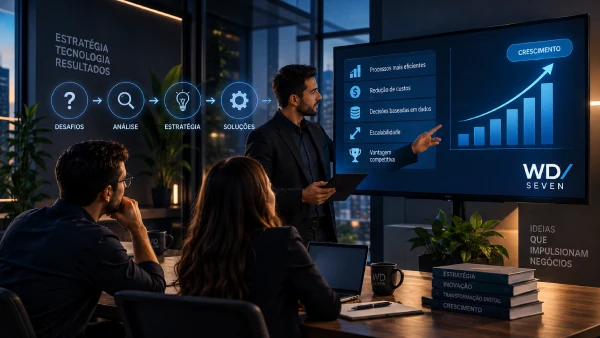


From Concept to Maintenance: The Complete Cycle
An enterprise web system is a complex investment. It doesn’t just "come out ready from code". It’s a methodological process with multiple stages, reviews, testing, and continuous refinements.
The difference between a system that fails and one that thrives is rigor in the early stages and discipline in maintenance.
In this guide, we will explore the 7 main phases of modern enterprise web system development.
Average Development Time
Small system (1-2 modules): 3-6 months. Medium system (5-10 modules): 6-12 months. Large/complex system (20+ modules): 12-24 months or more. Timeline varies depending on complexity, team, and methodology.
Phase 1: Planning and Scope
Understanding the Business
Before a single line of code, you need to understand: what is the problem? What is the solution? What is the value? Who are the users? What is the expected outcome?
What happens in this phase:
- Discovery meetings: Understand business, processes, pain points
- Scope document: What the system will do (and what it will NOT do)
- Functional requirements: Specific features, flows, behaviors
- Non-functional requirements: Performance, security, scalability
- Timeline estimation: How long it will take
- Budget: Total project cost
Typical duration: 2-4 weeks depending on complexity.
"Do not start development until you fully understand the problem. Weeks spent planning save months in refactoring."
— Agile Methodology
Phase 2: Design and Architecture
Designing the Technological Solution
With requirements in hand, architects design how the system will be. Which framework? Which database? How will it scale? How will it be secure?
What happens in this phase:
- System architecture: How components interact
- Database design: Table structure, relationships
- User flows: How users interact with the system
- Mockups/Prototypes: Visuals for approval before coding
- Technology stack: Frontend, backend, database, infrastructure
- Security plan: How data will be protected, authentication, authorization
Typical duration: 3-6 weeks. Critical phase - mistakes here are very costly later.
Phase 3: Development (Coding)
Writing the Code
Finally, developers write code. But it’s not chaotic — it’s structured, following standards, with code reviews and version control.
What happens in this phase:
- Frontend development: User interface, responsiveness, UX
- Backend development: APIs, business logic, processing
- Integration with external APIs: Payment, email, SMS, etc.
- Code review: Another developer reviews every piece of code
- Version control (Git): Tracking all changes
- Documentation: How the code works for future maintenance
Typical methodology: Agile with 2-week sprints. Each sprint delivers working features.
Typical duration: Largest portion of the project (40-60%).
Phase 4: Testing
Ensuring Everything Works
Finished code ≠ working code. Testers validate every feature, flow, and edge case to ensure quality.
What happens in this phase:
- Unit tests: Each function works correctly
- Integration tests: Components work together
- System tests: Entire system works as expected
- Acceptance tests: Client validates requirements
- Performance tests: Can it handle expected load?
- Security tests: Protection against known attacks
Typical duration: 3-8 weeks depending on complexity.
Phase 5: Security (Security Hardening)
Protection Against Attacks
Enterprise systems are targets for hackers. Security must be proactive, not reactive.
What happens in this phase:
- Penetration testing: Ethical hackers test vulnerabilities
- Code security review: Identify vulnerabilities
- HTTPS/SSL: Encrypted communication
- Strong authentication: Passwords, 2FA, biometrics
- Granular authorization: Controlled access
- Protection against SQL injection, XSS, CSRF
- Data encryption: Sensitive data protection
- Security logs: Tracking access and changes
Typical duration: 2-6 weeks (ongoing).
Phase 6: Deployment and Infrastructure
Going Live
The system moves from development to production environment with real users.
What happens in this phase:
- Cloud infrastructure: AWS, Azure, Google Cloud
- Server setup: Web server, database, cache
- Load balancing
- CDN
- Automatic backups
- Disaster recovery
- 24/7 monitoring
- CI/CD pipeline
Typical duration: 1-4 weeks.
Phase 7: Maintenance and Evolution
Keeping It Running and Evolving
After deployment, the work continues with maintenance, updates, and improvements.
What happens in this phase:
- Technical support
- Bug fixes
- Security updates
- Performance improvements
- New features
- Dependency updates
- Scalability adjustments
Duration: Ongoing.
Methodology: Agile vs Waterfall
Agile (Recommended)
Development in short cycles (2-4 weeks). Each cycle delivers features ready for feedback. If something changes, it is flexible to adapt.
Waterfall (Less Flexible)
Linear development: planning → design → coding → testing → deployment. Difficult to change mid-process.
Typical Technology Stack
Frontend
- React, Vue, Angular: Modern JavaScript frameworks
- Responsive design: Works on desktop, tablet, mobile
- State management: Redux, Vuex for managing data
- HTTP client: Axios or Fetch to communicate with backend
Backend
- Node.js, Python, Java, C#: Languages for business logic
- Express, Django, Spring: Web frameworks
- REST APIs or GraphQL: How frontend communicates with backend
- Authentication: JWT, OAuth for security
Database
- PostgreSQL, MySQL: Relational database (structured data)
- MongoDB: NoSQL database (flexible data)
- Redis: Fast cache for performance
DevOps/Infrastructure
- Docker: Containerization for consistency
- Kubernetes: Container orchestration
- AWS/Azure/GCP: Cloud hosting
- CI/CD: GitHub Actions, Jenkins for automated deployment
WD Seven Services: We Develop Enterprise Web Systems
At WD Seven, we develop enterprise web systems following best practices in every phase. From planning to continuous maintenance:
Consulting and Planning
We help define scope, requirements, and architecture. We ensure the system solves the right problem.
Explore serviceDesign and UX
Beautiful design that works. Wireframes, prototypes, user testing. Intuitive and scalable interface.
Explore serviceFull Stack Development
Complete frontend + backend. Clean, tested, scalable code. Agile with 2-week sprints.
Explore serviceQA and Testing
Unit, integration, and system testing. We find bugs before production. Quality guaranteed.
Explore serviceSecurity and Penetration Testing
Security audits, penetration testing, hardening. Vulnerabilities identified and fixed.
Explore serviceDeployment and Infrastructure
Cloud deployment, server configuration, automated CI/CD. Fast and reliable system 24/7.
Explore serviceMaintenance and Support
24/7 technical support, fast bug fixes, security updates. System always running.
Explore serviceMobile Applications
Native iOS and Android or React Native. Your system in the palm of your hand. Offline-first, automatic synchronization.
Explore serviceIntegrations and APIs
Connect with any system. Custom integrations, webhooks, data synchronization.
Explore serviceConclusion: Development Is a Process, Not a Destination
Enterprise web system development doesn’t end at deployment. It evolves continuously.
System quality is defined not only by code, but by discipline across every phase and continuous improvement.
Next Steps If You're Planning a System
1. Define scope
2. Estimate complexity
3. Define realistic budget
4. Define timeline
5. Choose the right partner
6. Plan before coding