

The Truth Nobody Tells You About Speed
There's a myth in the digital market: that investing in design, content, and paid traffic is enough to sell online. The truth is much harsher — if your site doesn't load in under 3 seconds, you're literally throwing money away.
This isn't opinion. It's science. It's math. It's human behavior in its most primitive form: the brain processes visual information in 13 milliseconds, but decides whether to stay or leave in less than 3 seconds. If your site hasn't appeared by then, the visitor is already gone — and took their money to your competitor.
In this article, we'll show real data from giants like Google, Amazon, Walmart, and Pinterest that prove: fast sites sell more, rank better, and convert visitors into loyal customers.
The 3-Second Rule
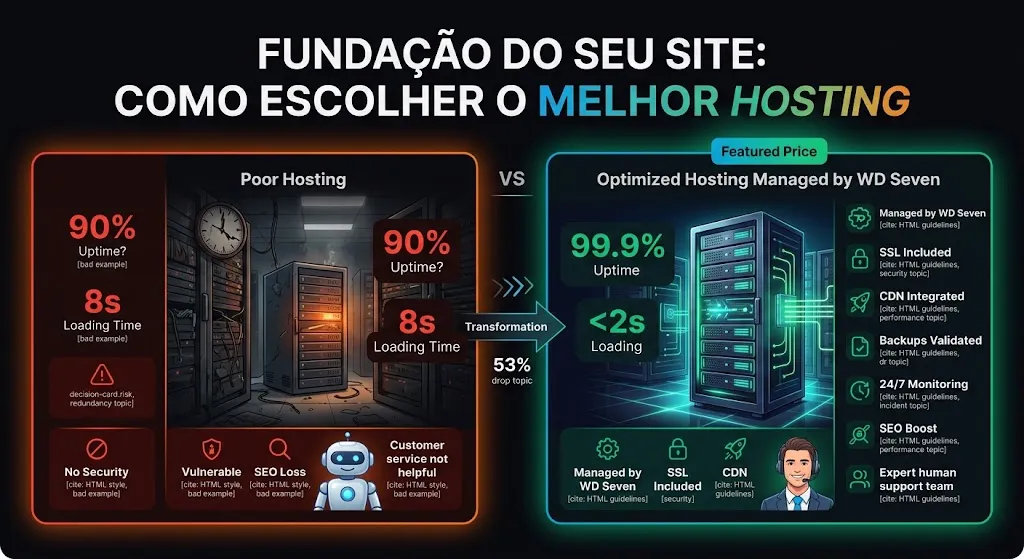
If your site doesn't load in 3 seconds, 53% of mobile users will leave. This isn't a technical problem — it's a revenue problem.
🚀 Want to find out how much your slow site is costing you?
We offer a free performance diagnosis and lost revenue estimate.
Real Data: The Financial Impact of Slowness
Forget theories. Let's look at the numbers that the world's largest companies discovered by testing, measuring, and optimizing their site speed. This data is public and comes from internal research published by the companies themselves.
100ms more = $1.6B/year
Every 100ms of slowness costs Amazon 1% of sales. At scale, billions in revenue.
500ms = -25% searches
Half a second of delay reduced daily searches by 25%. Users simply gave up.
1s faster = +2% conversion
For every second gained in speed, conversion rose 2%. Straight to the bottom line.
-40% wait time = +44% ad revenue
Reducing wait time by 40% increased ad revenue by 44% and signups by 15%.
// What happens when your site is slow:
+1s loading time = -7% conversions
+2s loading time = -14% conversions
+3s loading time = -21% conversions
+5s loading time = -35% conversions
// What happens when your site is fast:
LCP < 2s=+40% engagement
PageSpeed > 90 = +30% ranking
INP < 200ms=+25% retention
CLS < 0.1=+18% user trust
Important Data Point
According to a Deloitte study for Google, reducing load time by just 0.1s increased conversion rates by 8% for retail sites and 10% for travel sites. Speed is the investment with the highest ROI in digital marketing.
The Psychology Behind Digital Impatience
It's not just technology. It's human behavior. Your brain evolved to make quick decisions — and on the internet, this rule intensifies. Understanding user psychology is fundamental to understanding why speed equals sales.
🧠 The First Impression Effect
The human brain forms a first impression in 50 milliseconds. If the site doesn't load by then, the perception of quality drops drastically. Users associate slowness with amateurism and insecurity.
⏱️ Hick's Law and Quick Decisions
The longer users wait, the more they question their decision to be there. With every second of waiting, the probability of abandonment grows exponentially. Digital patience is measured in milliseconds.
💰 The Perception of Value
Fast websites convey professionalism, trust, and authority. Users are more willing to buy from brands that demonstrate care for the experience. Slowness generates distrust — and distrust kills sales.
🔄 The Cascade Effect
A frustrated user doesn't just leave — they share the negative experience. Complaints on social media, bad reviews on Google My Business, and negative word-of-mouth amplify the damage of slowness.
"Your site is the customer's first interaction with your brand. If it takes too long to load, the first impression is carelessness. And nobody buys from someone who seems careless."
How Google Ranks Fast Websites
Since 2021, with the introduction of Core Web Vitals, Google has made it clear: speed is an official ranking factor. Fast sites appear first. Slow sites are pushed to the following pages — where nobody sees them.
Loading Speed
Largest Contentful Paint. Target: < 2.5s. Measures how long the main content takes to appear.
Response Time
Interaction to Next Paint. Target: < 200ms. Measures responsiveness to user actions.
Visual Stability
Cumulative Layout Shift. Target: < 0.1. Prevents jumps and unexpected screen movements.
Slow Site on Google
Positioning: later pages, off the radar.
Organic traffic: low, insufficient to sustain the business.
Credibility: Google doesn't recommend sites that deliver poor experiences.
Result: fewer clicks, fewer sales, less revenue.
Fast Site on Google
Positioning: first page, highlighted in results.
Organic traffic: high, qualified, and free.
Credibility: Google recommends sites that deliver good experiences.
Result: more clicks, more sales, more predictable revenue.
🔍 Want to know where your site ranks on Google?
We provide complete positioning and performance analysis.
Speed at Every Stage of the Sales Funnel
Speed doesn't just impact one stage — it influences the entire funnel. From attraction to conversion, every second counts. See how performance affects each phase of the customer journey:
Attraction (Top of Funnel)
Fast sites rank better on Google. More visibility = more free organic traffic. Every second gained in performance can mean thousands more visitors per month.
Engagement (Middle of Funnel)
Users stay longer on fast sites. They browse more pages, consume more content, and build connection with the brand. Retention increases by up to 40%.
Consideration (Bottom of Funnel)
Fast sites convey trust. Users feel more secure adding products to cart, filling out forms, or requesting quotes. The perception of quality increases dramatically.
Conversion (Moment of Sale)
At checkout, every millisecond matters. Slow sites at the payment moment generate abandonment. Fast sites close sales. The difference can be 20-30% in conversion rate.
Loyalty (Post-Sale)
Customers who had a good experience come back. Fast sites create habits. Customer retention is 5x cheaper than acquiring new ones — and speed is a fundamental part of that experience.
Strategic Insight
Speed isn't just a technical detail — it's a complete business strategy. It impacts attraction, engagement, consideration, conversion, and loyalty. Ignoring performance is ignoring revenue.
Real Cases of Companies That Profited from Speed
These aren't just theories. These are documented cases of companies that turned speed into profit. See real examples:
AliExpress
Reduced load time by 36% and increased conversions by 10.4%. For each day of improvement, 259 new orders.
BBC
Lost 10% of users for every additional second of loading. Invested in performance and recovered audience.
AutoAnything
Halved page load time and increased sales by 12% and conversions by 9%.
Reduced wait time by 40%. Result: +44% ad revenue and +15% signups.
Financial Times
Optimized performance and increased engagement by 30%. Users spent more time reading content.
Zalando
Reduced loading by 100ms and increased conversions by 0.7%. At scale, millions in additional revenue.
"These numbers aren't exceptions — they're the rule. Every company that seriously invests in performance reaps measurable financial results. The question isn't whether it works, but how much you're losing right now."
Checklist: Is Your Site Losing Sales?
Evaluate honestly. If your site has more than 3 of the problems below, you're leaving money on the table every day.
Loading time over 3 seconds
53% of users abandon sites that take more than 3s to load.
PageSpeed Score below 70
Google doesn't recommend sites with low scores. You lose positions and traffic.
Unoptimized images (heavy PNG/JPG)
Images are the biggest performance villain. Without WebP/AVIF, your site is slow.
No CDN or cache configured
Content isn't delivered quickly to users in different regions.
Unstable layout (jumping elements)
High CLS irritates users and hurts Google ranking.
Slow or freezing checkout
At the moment of sale, every millisecond counts. Checkout slowness = abandonment.
Site doesn't work well on mobile
Over 60% of traffic comes from mobile. If it's not mobile-first, you're losing sales.
Bounce rate above 60%
Users enter and leave without interacting. Clear sign of performance problems.
⚠️ Identified 5+ problems? You're losing sales right now.
Schedule a free diagnosis and find out how much your slow site is costing.
How to Make Your Site Faster (and More Profitable)
Improving performance isn't magic — it's engineering. See the steps we follow to transform slow sites into conversion machines:
Complete Performance Audit
We analyze Core Web Vitals, load time, page weight, HTTP requests, and identify the bottlenecks killing your conversions.
Image and Media Optimization
Conversion to WebP/AVIF, lazy loading, intelligent compression, and CDN delivery. We reduce image weight by up to 80% without quality loss.
Code Minification and Compression
HTML, CSS, and JavaScript minified and compressed with Brotli/Gzip. We reduce file sizes by up to 70%.
CDN and Cache Implementation
We configure global CDN (Cloudflare, Vercel) and smart caching to deliver content quickly to users anywhere in the world.
Rendering Optimization
We implement SSR/SSG/ISR to ensure pages load instantly. Critical CSS inline and non-critical resources loaded on demand.
Continuous Monitoring
We track Core Web Vitals in real-time, identify regressions, and continuously optimize to maintain elite performance.
Is your current site holding back your growth?
We transform slow sites into fast, scalable platforms optimized for conversion.
Solutions to Accelerate Your Sales
From audit to implementation, we offer complete solutions to turn speed into revenue.
Strategic Consulting
Complete performance diagnosis and action plan to accelerate your site and increase conversions.
📈Scalable Platforms
We build sites and e-commerce with modern architecture, elite performance, and impeccable technical SEO.
🏢Enterprise Applications
Integrated solutions focused on UX and high performance for complex businesses.
🔄Systems Modernization
We transform legacy systems into modern, fast platforms optimized for conversion.
🔗Integrations & APIs
We connect systems and platforms with secure, efficient APIs that don't compromise performance.
🚀Performance Optimization
Continuous monitoring, fine-tuning, and constant improvements to maintain elite performance.
Conclusion
The answer is clear and proven by data: fast websites sell more. It's not opinion, it's not a trend — it's fact. Every millisecond of performance improvement translates to more sales, more organic traffic, and more revenue.
The three essential pillars: Speed, Experience, and Trust. Without one of them, you're leaving money on the table. Fast sites aren't a luxury — they're a competitive necessity.
Speed
Instant loading, maximum conversion
Experience
Satisfied users, more sales
Revenue
Performance = revenue
The question is no longer "should I invest in performance?" — it's "how much am I losing right now?". Get a diagnosis, implement improvements, measure results. Your fast site is your best salesperson.
"Speed isn't a technical detail — it's a business strategy. Fast sites don't just sell more, they dominate the market."