

What Is Cloud for Enterprise Systems
Cloud for enterprise systems means using remote computing infrastructure (servers, storage, databases, networks) to run your business applications — without needing to buy, maintain, or manage physical hardware.
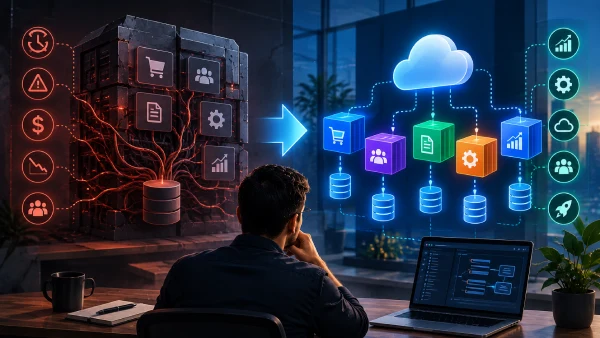
Historically, companies had their own servers in climate-controlled rooms. IT teams spent months provisioning hardware. If the system grew, they had to buy more equipment. If it went down, the business stopped.
Cloud changes that. You rent computing capacity on demand. Pay for what you use. Scale in minutes. Providers like AWS, Azure, and Google Cloud guarantee world-class availability, security, and performance.
Practical Definition
Enterprise cloud is infrastructure as a service: computing, storage, networking, and databases delivered over the internet, with SLA, enterprise security, and automatic scalability.
🚀 Need cloud infrastructure for your company?
We implement custom cloud solutions with AWS, Azure, and GCP.
On-Premise vs Cloud: The Real Difference
Understanding the difference between traditional infrastructure and cloud is essential for making the right decision. It's not just about "moving things somewhere" — it's a complete change in operational model.
On-Premise Model
Timeline: Purchase server (2 months) → Installation (1 month) → Configuration (weeks) → System live.
Growth: Need more capacity? New purchase. Another 3 months of waiting.
Cost: High CAPEX. Hardware + energy + cooling + specialized team.
Risk: If the server goes down, the business stops. No automatic redundancy.
Cloud Model
Timeline: Provision resources in minutes. System live on the same day.
Growth: Auto-scaling. Demand spikes? Scales automatically.
Cost: OPEX. Pay for usage. No upfront hardware investment.
Risk: Multi-AZ, automatic failover, continuous backup. 99.99% uptime.
"Cloud isn't about technology. It's about business agility: launching faster, scaling without fear, and paying only for what you use."
Cloud Security: Enterprise-Grade Protection
Security is the #1 concern for companies migrating to the cloud. The good news: leading cloud providers invest billions of dollars annually in security — far more than any company could invest on its own.
End-to-End Encryption
Data encrypted in transit (TLS 1.3) and at rest (AES-256). Managed keys or customer-provided keys (BYOK).
Zero Trust Architecture
Nothing is trusted by default. Every request is authenticated, authorized, and encrypted. Network micro-segmentation.
Compliance & GDPR
ISO 27001, SOC 2, PCI-DSS, HIPAA certifications. Regional data residency for regulatory compliance.
Threat Detection & SIEM
24/7 monitoring with AI. Real-time anomaly detection. Automated incident response.
IAM & MFA
Granular access control with least-privilege principle. Mandatory multi-factor authentication.
Backup & Disaster Recovery
Automated backups with cross-region replication. RPO of minutes. RTO of hours. Regular DR tests.
Important Data
IBM studies show that companies in the cloud experience 2.5x fewer breaches than on-premise companies. Cloud security is, on average, superior to local infrastructure.
🔒 Need enterprise security for your systems?
We architect cloud solutions with DevSecOps and GDPR compliance.
Scalability: Grow Without Limits
Scalability is cloud's superpower. Does your system need to handle 100 to 10 million users? Cloud does that without rewriting a single line of code.
📈 Vertical Scaling (Scale Up)
Increase a machine's resources: more CPU, more RAM, more disk. Simple, but has a physical limit.
🔄 Horizontal Scaling (Scale Out)
Add more machines to the pool. Virtually unlimited. This is where cloud shines for enterprise systems.
⚡ Intelligent Auto-Scaling
Cloud scales automatically based on metrics: CPU, memory, requests, queues. Scales up when demand grows. Scales down when it drops. Pay only for what you use.
// Normal traffic: 500 req/s
Active instances: 3
// Black Friday starts: 50,000 req/s
Auto-scaling triggers: 3 → 80 instances in 90 seconds
// Black Friday ends: traffic returns to normal
Scale down: 80 → 3 instances in 5 minutes
// Extra cost: only for the 4 peak hours
Savings vs. keeping 80 servers fixed: ~$36,000/month
📊 Does your system need to scale without limits?
We develop scalable platforms with cloud-native architecture.
Performance: Speed and Availability
Performance in the cloud isn't just about speed — it's about user experience, conversion, and revenue. Every second of latency costs millions in e-commerce. Every minute of downtime destroys trust.
Global Latency
CDN with 200+ points of presence worldwide
Availability
Enterprise SLA with automatic failover
Time to First Byte
Edge computing and cache optimization
Cloud Performance Techniques
CDN (Content Delivery Network)
Static content served from the edge closest to the user. Reduces latency by up to 70%. CloudFront, Cloudflare, Akamai.
Multi-Layer Caching
Redis/Memcached for frequent data. CDN for assets. Browser cache for returning users. Reduces database load by 90%.
Optimized Databases
Read replicas, connection pooling, smart indexing. Aurora, Cloud SQL, Cosmos DB with automatic scalability.
Serverless & Edge Computing
AWS Lambda, Azure Functions, Cloudflare Workers. Code executed at the edge, closer to the user. Cold start in milliseconds.
Heads Up
Cloud isn't a silver bullet. Performance depends on correct architecture. Poorly designed microservices, inefficient queries, and lack of caching can make cloud slower than on-premise. Designing for cloud requires expertise.
Cloud Deployment Models
There's no "one cloud" for everyone. Different companies need different models. Know the options and choose the ideal one for your scenario.
Public Cloud
AWS, Azure, GCP. Provider's infrastructure. Pay for usage. Ideal for most cases.
Private Cloud
Dedicated infrastructure. Maximum control and security. For sensitive data or strict compliance.
Hybrid Cloud
Public + Private. Maximum flexibility. Sensitive data on private, variable workload on public.
Multi-Cloud
Multiple providers (AWS + Azure + GCP). Avoids vendor lock-in. Better pricing and resilience.
Industry-Specific Cloud
Cloud with specific services for healthcare, finance, retail. Sector compliance included.
Serverless
No server management. Functions execute on demand. Pay per execution. Maximum savings.
Checklist: Is Your Company Ready for Cloud?
Before migrating, evaluate whether your organization is prepared. Answer each item honestly — this defines the ideal strategy.
Current infrastructure cost > $10K/month
If you spend a lot on servers, energy, and infra team, cloud is likely cheaper.
Growth limited by infrastructure
Need to wait weeks/months to provision new resources? Cloud solves it in minutes.
Need for high availability (99.9%+)
If downtime is expensive (sales, reputation), cloud offers automatic redundancy.
Unpredictable demand spikes
Black Friday, launches, viral campaigns? Cloud scales automatically.
Remote or distributed team
Teams in multiple cities/countries? Cloud facilitates access and collaboration.
Compliance requirements (GDPR, ISO, PCI)
Cloud providers already have certifications. You inherit compliance without extra effort.
Legacy systems need modernization
Old systems blocking innovation? Cloud + modernization is the way.
Want to use AI, ML, and advanced technologies
Cloud providers offer ready-to-use AI/ML APIs. Local servers don't.
🎯 Identified 5+ signs? Time to act.
Schedule a free strategic consultation with our specialists.
How to Implement Cloud in Your Company
Migration to the cloud isn't "lift and shift". It's a transformation that requires planning, phased execution, and continuous optimization.
Assessment & Discovery
Map all systems, dependencies, performance and compliance requirements. Identify workloads and define migration priorities.
Cloud-Native Architecture
Design architecture for cloud: microservices, containers, serverless where applicable. Define networking, security, monitoring, and CI/CD.
Phased Migration
Start with non-critical workloads. Validate, learn, adjust. Migrate critical systems last with confidence.
DevSecOps & CI/CD
Implement automated deployment pipelines. Security integrated from the start (shift-left). Infrastructure as Code with Terraform.
Continuous Optimization
Monitor costs, performance, and security. Right-size instances. Reserved instances for savings. Continuous improvement.
🔄 Legacy systems blocking your innovation?
We modernize legacy systems into cloud-native architectures.
Cloud Solutions for Your Business
From consulting to implementation, we offer everything your company needs for a successful cloud journey.
Cloud & DevOps
Cloud infrastructure, CI/CD, Kubernetes, IaC, and complete deployment automation.
📈Scalable Platforms
Cloud-native architectures prepared for exponential growth with microservices.
🏢Enterprise Apps
High-performance applications integrated with cloud and legacy systems.
🔄Systems Modernization
We transform legacy systems into modern, scalable cloud architectures.
🔗Integrations & APIs
We connect systems, APIs, and services in distributed cloud architectures.
🎯Strategic Consulting
Technology roadmap, architecture analysis, and cloud project governance.
Conclusion
Cloud for enterprise systems is no longer optional — it's strategic. Companies that adopt cloud gain speed, reduce costs, and eliminate growth barriers.
The three pillars — security, scalability, and performance — are delivered natively by major cloud providers, but require correct architecture to generate real results.
Security by Design
Zero Trust, encryption, compliance
Unlimited Scale
Auto-scaling, multi-region, global
Maximum Performance
CDN, edge computing, 99.99% uptime
The question isn't "if" your company should go to the cloud — it's "when" and "how". Start with a strategic assessment, migrate in phases, and optimize continuously. The result: a more agile, secure business ready for the future.
"The cloud isn't a destination — it's the starting point for continuous innovation."